Showing posts with label landscape. Show all posts

Thursday, 14 May 2020

2/2 First Covid-19 Lockdown Cycle Ride, Dover Seafront, UK

A permitted Coronavirus cycle ride along the promenade from the Eastern Docks to the New Marina Pier, Port of Dover, Kent, England, UK.

After the video there are close-ups of numbers 11 to 20 of the mainly historical local landmarks that are mentioned in the commentary.

The previous post, 1/2 First Covid-19 Lockdown Cycle Ride, contains close-ups of landmarks 1 to 10 (nb "First" in both titles indicates that I'll be making another video of the same route):


The video was filmed on Sunday, 10th of May 2020, using a head-mounted GoPro Hero 8 Black action camera and its built-in microphones.


Entrance to what was once a builder's yard in Tower Hamlets at 13 West Street, CT17 0DU, Dover, England. This is where I live and do private research into Evolution (Internal Evolutionary Mechanism), Psychology (The Archeotrauma, Trauma), and aspeccts of Social Psychology.
Time Lapse Video Start

Two days later I made a three-minute GoPro "Time Warp" (time lapse) video with commentary.

It contains a sequence that also shows the promenade from the Eastern Docks to the New Marina Pier.

Local landmarks, numbers 11 to 20:

Click on a thumbnail for a larger view, or any text link to go to the related blog post.


Victorian Waterloo Crescent Grade II Listed Building. Marine Parade. DHB's Harbour House. Best Western Dover Marina Hotel and Spa, ex-Churchill Hotel, White Cliffs Hotel (Eisenhower and Churchill in WW2), part of ex-Shalimar Hotel right. Royal Cinque Ports Yacht Club.
White Cliffs Hotel at Sunrise
Former White Cliffs Hotel, Waterloo Crescent

Where Prime Minister Churchill and President Eisenhower had dinner during the Second World War.

Now the Best Western Dover Marina Hotel and Spa.

Fairbairn Crane pre-restoration (2011)
Fairbairn Crane

Swan-neck tubular crane of 1868 on Esplanade Quay, ex-Ordnance Quay of Wellington Dock.

There's a working steam-powered version in Briatol

A Grade II Listed Building.

Triple spiral staircase linking Grand Shaft Barracks to Snargate Street. Built on Western Heights 1805-1807 in Napoleonic Wars. Lieutenant (Quartermaster) Charles Wooden, Victoria Cross, died in barracks above in 1876; he rode in Charge of the Light Brigade, Balaclava, Crimean War, 1854.
Grand Shaft, Pentax K100D  (2011)
The Grand Shaft

Triple spiral staircase built during the Napoleonic Wars.

Linked the Grand Shaft Barracks on top of the Western Heights cliffs to Snargate Street below.

Keep built 12th Century by Henry II's Norman architect, Maurice the Engineer (mason), with corner towers and pilaster buttress. English Heritage, Listed building. Medieval Royal Palace of King's Hall, King's Chamber, Guest Hall, and Guest Chamber. View from King's Gateway.
View of the Keep from King's Gate
The Keep, or Great Tower of Dover Castle

Built in AD 1180's by Maurice the Engineer for King Henry II

Contains reconstructed medieval royal palace.

English Heritage Listed Building and Ancient Monument.

Pharos lighthouse built 46 AD, Emperor Claudius, Aulus Plautius governor. Bredenstone: Western Heights. Once St Mary-in-Castro belfry, King Lucius Church. Restored: Gilbert Scott, William Butterfield. Garrison School. Officers New Barracks or Officers Mess. Fire Beacon, English Channel.
St Mary-sub-Castro and Pharos
Saxon St Mary-in-Castro Church and Roman Pharos

Church is 10th century AD, restored by the Victorians.

Lighthouse built AD 46, reign of Emperor Claudius.

Both lie in grounds of Norman 12th century Dover Castle.

Situated on the White Cliffs of Dover overlooking the English Channel. Microwave tower, or mast on the left, radar scanner, or antenna on the right. Low roof of the operations room (control center) is in the middle.
HM Coastguard Station, Dover
HM Coast Guard Station Dover

Located at Langdon Battery, Swingate, on the White Cliffs of Dover overlooking the English Channel.

Two masts of Second World War Swingate Chain Home Radar Station, ex-RAF Swingate, now Swingate Transmitting Station. Also: Coastguard Cottages, Broadlees Bottom, A2 Jubilee Way bypass, White Cliffs of Dover, Eastern Docks, Dover harbour from Prince of Wales pier.
A2 Jubilee Way, Eastern Docks
A2 Jubilee Way Flyover

From Broadlees Bottom, low point in the White Cliffs of Dover, to the Eastern Docks.

Also World War Two Swingate radar masts and former Coast Guard Cottages.

Cross-Channel ferries in front of Eastern Arm pier with Eastern Entrance and English Channel on the right. Owner: P&O Ferries. Route: Dover to Calais (France). MS Spirit of France (departing, left). MS Pride of Canterbury (arriving, right). Port of Dover, DFDS Ferries also an operator.
In front of Eastern Arm pier (2012)
Cross-Channel Ferries

P&O Ferries' MV Spirit of France is on the left and MV Pride of Canterbury is on the right.

DFDS Ferries also operates from the Eastern Docks.

Holland America Line. From Copenhagen (Denmark), going to Amsterdam (Netherlands). Call sign PFRO, IMO 8919257. Southern Breakwater, Western Docks. Also: Western Entrance, Dover Breakwater West End Light, Admiralty Pier Lighthouse. Kent, England.
MV Maasdam, Holland America Line
Western Entrance of Dover Harbour

Southern Breakwater on the left, Admiralty Pier on the right.

Lighthouses undergoing restoration in 2010.

Prince of Wales Pier Light was built 1902. 46 feet high stone tower. Very quick flashing green light VQ, 100+ flashes per minute. Cafe behind lighthouse. Gateway Flats on seafront. Taken from above Cruise Terminal 3, Admiralty Pier, Dover Western Docks Revival.
POW Pier Lighthouse in 2010.
Prince of Wales Pier Lighthouse 

Built 1902. 46 feet high stone tower.

Very quick flashing green light VQ, 100+ flashes per minute.

Cycling route map and biometrics are on this Polar Flow web page.

Abridged versions of this post are also on Facebook and Twitter.

Wednesday, 13 May 2020

GoPro Hero 8 Timewarp Cycle Video, Urban Coast, Dover, UK

A first attempt (with commentary) at a time lapse video made on Tuesday, 12th of May 2020 - the last day of full Coronavirus Lockdown restrictions as they applied to exercise in England:


All I did was select "Time Warp", the resolution, a linear lens aperture (as opposed to "fish-eye"), and then pressed  the "Start" and "Stop" buttons on my GoPro Hero 8 Black action camera as and when necessary.

Every other setting was selected by the camera's software (I may start messing about with the controls before making another time lapse video, but quite frankly, there just aren't enough hours in the day!)

The video's resolution is 1080p at 30 frames per second. It is 3 minutes long and took over 8 hours to upload to YouTube.

I would shoot 1080p at 60fps, 2.7K or even 4K, if it wasn't for the upload time overhead (plus my clockwork computer isn't exactly sympathetic towards video editing).

Nevertheless, I'm still very pleased with the results 😀

Cycling from the Eastern Docks along the seafront promenade above the pebble beach to the New Marina Pier of Dover Western Docks Revival (DWDR). ommentary identifies 20 local landmarks, mostly of historical interest. Filmed using a GoPro Hero 8 Black action camera.
First Seafront Cycling Video
A conventional video of a bike ride along the seafront promenade between the Eastern Docks and New Marina Pier identifies 20, mostly historical, local landmarks.

The time warp video route map (of what has become my "standard" daily bike ride) was plotted by a Polar Beat smartphone app in conjunction with a Polar H10 heart rate monitor (review):


A GoPro Hero 8 Black, Time Warp" video made on 12th of May, 2020 - last day of full Covid-19, or Coronavirus Lockdown restrictions applicable to England.  6 Robsons Yard (Tower Hamlets) to Buckland Bridge, Eastern Docks, Dover Western Docks Revival (DWDR) and back.


Outward Route:


Entrance to Robsons Yards Flats, 13 West Street, Dover, Kent, England. Where I (John Latter) do private research into Evolution (a testable Internal Evolutionary Mechanism), Psychology (The Archaeotrauma, Trauma), and Social Psychology. Southern Housing Group.
1-6 Robsons Yard Flats, Tower Hamlets, Dover in 2009.

6 Robsons Yard, West Street, East Street, Tower Hamlets Road, De Burgh Street, Templar Street, London Road, Buckland Bridege.

Buckland Avenue, Barton Road, Frith Road, Salisbury Road, Albert Road, Maison Dieu Road, Woolcomber Street.

A20 Townwall Street, East Cliff, Athol Terrace, East Cliff (Marine Parade).

Dover seafront promenade from the Eastern Docks to the New Marina Pier (Dover Western Docks Revival, DWDR).

Return Route:


A20 Limekiln Street goes to Snargate Street, Townwall Street, and Eastern Docks. Archliffe Road goes to Folkestone. The Viaduct Flyover goes to Admiralty Pier; Elizabeth Street, Bulwark Street, and Hawkesbury Street. Car Wash. Near Port of Dover. Night photography.
Light Trails on Limekiln Roundabout at Night (2010)


New Marina Pier to the Esplanade, Union Street, A20 Limekiln Street to Likekiln Roundabout (that I called Limehouse Roundabout in the video!).

Limekiln Roundabout, Limekiln Stret, Prince of Wales Roundabout, Snargate Street, York Street Roundabout.

York Street, Folkestone Road Roundabout, Folkestone Road, Priory Station Approach Road, Dover Priory Rail Station, Dover Priory Roundabout.

Priory Station Approach Road, Folkestone Road, Folkestone Road Roundabout, Priory Street, High Street.

Tower Hamlets Road, East Street, West Street, 6 Robsons Yard.

Original route map and biometrics (after I remembered to connect my heart rate monitor!) are on this Polar Flow web page.

Abridged versions of this post are also on Facebook and Twitter.
 

Monday, 11 May 2020

1/2 First Covid-19 Lockdown Cycle Ride, Dover Seafront, UK

A permitted Coronavirus cycle ride along the promenade from the Eastern Docks to the New Marina Pier, Port of Dover, Kent, England, UK.

After the video there are close-ups of numbers 1 to 10 of the mainly historical local landmarks that are mentioned in the commentary.

A second post, 2/2 First Covid-19 Lockdown Cycle Ride, contains close-ups of landmarks 11 to 20 (nb "First" in both titles indicates that I'll be making another video of the same route):


The video was filmed on Sunday, 10th of May 2020, using a head-mounted GoPro Hero 8 Black action camera and its built-in microphones.


Entrance to what was once a builder's yard in Tower Hamlets at 13 West Street, CT17 0DU, Dover, England. This is where I live and do private research into Evolution (Internal Evolutionary Mechanism), Psychology (The Archeotrauma, Trauma), and aspeccts of Social Psychology.
Time Lapse Video Start

Two days later I made a three-minute GoPro "Time Warp" (time lapse) video with commentary.

It contains a sequence that also shows the promenade from the Eastern Docks to the New Marina Pier.

Local landmarks, numbers 1 to 10:

Click on a thumbnail for a larger view, or any text link to go to the related blog post.


Georgian listed building built in 1834. Charles Lightoller moved here in 1916 in the Royal Navy's Dover Patrol, serving on the destroyer HMS Falcon. He once applied for The Spanish Prince which became a blockship in Dover Harbour in 1915.
Charles Lightoller in Dover
8 East Cliff, Marine Parade

Former home of Charles Lightoller, survivor of the 1912 RMS Titanic iceberg disaster.

Moved here in 1916 during World War One after joining the Dover Patrol.

Born 1824, educated King's School Canterbury, entered Bengal Artillery 1842. Transferred Royal Artillery after Indian Mutiny 1857. Married 1863. Made Knight Commander Order of the Bath, Queen Victoria's Diamond Jubilee 1897, died 1 East Cliff 1899.
1 East Cliff (Marine Parade), Dover
1 East Cliff, Marine Parade

Former home of General Sir Henry Le Geyt Bruce, Knight Commander of the Bath, 1824-1899.

Transferred from Bengal Artillery to Royal Artillery after 1857 Indian Mutiny.

Seaplane Station

First World War RAF or RFC squadron location.


The Mote, or Moat's Bulwark artillery battery has a semi-circular lower level or gun platform and an upper level terrace containing the West Gatehouse or Guardroon ruins. Built by King Henry VIII in 1539, one of his 'little forts'. Re-developed during the Napoleonic Wars.
Moat's Bulwark, A20 Townwall Street
Mote's Bulwark, White Cliffs below Dover Castle 

One of King Henry VIII's 'little forts' of which there were three in Dover.

The other two being the Black Bulwark and Archcliffe Fort.
Autumn (Fall) panorama of Norman Keep and Dover Castle on the Eastern Heights above River Dour valley and Dover Harbour. Houses of Victoria Park above Gateway Flats apartments. Marine Parade Gardens and promenade. History, Travel, and Tourism.
Dover Castle and Gateway Flats
The Gateway Flats

Built as a result of damage sustained during the Second World War.

The Gateway, with 221 flats that all have views of the English Channel, was completed in October 1959 at a cost of one million pounds.

Victorian former Lord Warden Hotel in the Western Docks. Built by architect Samuel Beazley between 1848-1853. Royal Navy's HMS Wasp Shore Station in World War II. Now Lord Warden House used by freight agents. Grade II Listed Building. Port of Dover, Kent, England.
Lord Warden House, DWDR
Lord Warden Hotel (now Lord Warden House)

Where Louis Blériot (link to blog post) had breakfast after the first flight across the English Channel in 1909.

Ex-HMS Wasp in World War II. Now used by freight agents.

Statue of Matthew Webb who first swam the English Channel on 25 August, 1875, symbolically resting on fish and seashell. Located on seafront between Gateway Flats and Promenade above beach. Webb died trying to swim Whirlpool Rapids below Niagara Falls 24 July 1883.
Matthew Webb, Dover Seafront
Captain Matthew Webb

Bust (or statue) symbolically rests on fishes and seashell above  plinth,

First recorded person to swim the English Channel in 1875. Died Niagara Falls 1883 (USA and Canada border).

Commemorates Rolls' non-stop return flight across English Channel, 2nd June 1910. Co-founder Rolls Royce motor cars. Statue in front of seafront Gateway Flats facing English Channel. Matthew Webb bust is nearby. Skyline: Roman Pharos, St Mary-in-Castro church, Dover Castle.
Charles Rolls facing Strait of Dover
Statue of Charles Rolls, Dover Seafront

In 1910, he became the first man to fly non-stop across the English Channel and back again.

Co-founder of the Royal Aero Club and Rolls-Royce Motor Cars.

Sculpture by Mark Humphrey on Marine Parade commemorates the 100th anniversary of the end of the Great War (World War One) on November the 11th, 1918. Camden Crescent and distant King's Arms Library shown; plinth where 'The Waiting Miner' once stood is nearby.
Every One Remembered Statue
WW1 Every One Remembered Statue

First World War Centenary Commemorative Sculpture by Mark Humphrey.

Located in Granville Gardens, symbolically facing the English Channel, France, and the Western Front beyond.

Two-dimensional silhouette statue of Jamie Clark, 2012 Olympic Torch holder; Dame Vera Lynn who sang There'll be Bluebirds over the White Cliffs of Dover in World War Two; Ian Fleming, author of 007 James Bond novels who lived at St Margaret's-at-Cliffe. Marine Parade.
Dover Seafront Promenade
Sustrans Portrait Bench, Marine Parade

Silhouette sculpture of Jamie Clark, 2012 Olympic Games Torch holder; Dame Vera Lynn (WW2 song, There'll be Bluebirds over the White Cliffs of Dover; Ian Fleming, author of 007 James Bond novels.


Cycling route map and biometrics are on this Polar Flow web page.

Abridged versions of this post are also on Facebook and Twitter.


Monday, 4 May 2020

CPV Hunter, UK Border Force, Port of Dover, Kent, England

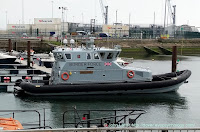
The 20m HMC Hunter, also termed CPV Hunter ('Coastal Patrol Vessel') of the UK Border Force berthed in the Inner Tidal Harbour, part of the Marina:in the Port of Dover::


Her Majesty's Cutter Hunter, also CPV Hunter ('Coastal Patrol Vessel'). One of 8 BP ARRC's (British Petroleum 'Autonomous Rescue and Recovery Craft') purchased by UK Government in 2016. In Inner Tidal Harbour of Marina with Clock Tower and former Lifeboat Station behind.
HMC Hunter on Monday the 4th of May, 2020. Camera: Google Pixel 2

Her Majesty's Cutter Speedwell, also CPV Speedwell (Coastal Patrol Vessel). One of 8 BP ARRC's (British Petroleum 'Autonomous Rescue and Recovery Craft') purchased by UK Government 2016. Inner Tidal Harbour of the Marina. Dolphin Hard and Jetty, Lifeboat RNLB 17-09 City of London II.
CPV Speedwell  MV Oceana cruise ship
A post about CPV Speedwell, who was also in port this day, is linked to on the left.

Dover Clock Tower.
Above CPV Hunter in the main photo is the clock tower, and to its left, the roof of the former lifeboat station.

Click thumbnail to see a larger size.

A Maritime Mobile Service Identity (MMSI) is a series of nine digits which are sent in digital form over a radio frequency channel in order to uniquely identify a ship or vessel.

The MMSI for CPV Hunter is 235118133 which enables her to be tracked in real-time on an AIS ('Automatic Identification System') map:


A 2017 Freedom of Information request (FOI 45061) stated:

I am able to disclose Border Force bought eight (8) x BP ARRC's ('Autonomous Rescue and Recovery Craft'), later renamed as coastal patrol vessels (CPV's) from Delta at a total cost of C£1m, these being all of the eight ex-BP vessels. As at today’s date, we have no immediate plans to purchase more. 

I have no further technical information specifically for CPV Hunter but surmise from the above that it is similar to that of HMC Active:

Built in 2006, CPV Hunter served as an Autonomous Rescue and Recovery Craft in the North Sea for supporting oil platform operations.

CPV Hunter was operated as a daughter craft from a larger offshore support vessel and launched when needed via a davit.

The design includes a deep-vee hull design constructed from fibre-reinforced plastic.

The design is also self-righting and can return to the upright position if capsized.

Propulsion: CPV Hunter is fitted with twin Caterpillar C18 engines driving twin water jets through a pair of reduction gearboxes

The total installed power of 1,288 kW (1,727 hp) gives CPV Hunter a top speed of 34 knots (63 km/h) in calm seas, or up to 24 knots (44 km/h) in seas up to 7 metres (23 ft) significant wave height.

A second view of Her Majesty's Cutter Hunter:


Her Majesty's Cutter Hunter is also called CPV Hunter ('Coastal Patrol Vessel'). One of eight BP ARRC's (British Pertoleum 'Autonomous Rescue and Recovery Craft') purchased by UK Government in 2016. DHB 'Harbour House',Wellington Dock swing-bridge, Dover Castle in view.
HMC Hunter on the 4th of May, 2020. Camera:Canon 600D DSLR

The United Kingdom Border Force is a law enforcement agency within the Home Office who secure the national borders by carrying out immigration and customs controls for people and goods entering the country.

As an example of HMC Hunter's involvement in this role, in 2019 she was involved in an incident in which twenty six people including eight children were picked up after crossing the English Channel.

Today, the Coronavirus pandemic has made the working life of her crew even more hazardous than before (not least because desperate illegal migrants are hardly in a position to practice social distancing).

My hat goes off to them as it does to those employed in another Dover "front line", Buckland Hospital.

The HMC Hunter photographs were taken from Crosswall Quay in the Port of Dover during a permitted Coronavirus bike ride.

Covid-19 lockdown: a cycling route map and biometrics can be seen on this Polar Flow web page.

Abridged versions of this post are also on Facebook and Twitter.

Sunday, 3 May 2020

Sergeant-Major's House Holiday Cottage, Dover Castle, UK

Dover Castle is a Grade I Listed Building owned by English Heritage who have converted two of the castle's buildings, Peverell's Tower and the Sergeant-Major's House, into "Holiday Cottages".


Built by King John and Henry III. Also known as Peverell's Gate, Peverell's Tower; Marshal's Tower, Beauchamp's Tower, and Bell Tower. An English Heritage Listed Building and Ancient Monument. Also visible: drawbridge and roof of the Georgian Sergeant Major's House.
Rare view of Peverell's Gate
An earlier post about the Peverell's Tower holiday cottage is linked to on the left.

Also see The Unusual Design of the Sergeant-Major's House.

Introduction 

A brief description of the main photograph and the position of the Sergeant-Major's House within it:


Concentric 12th Century Norman castle. The Keep (Great Tower) is surrounded by Inner Curtain Wall (Inner Bailey) with Palace Gate. Georgian Sergeant-Major's House is near Knight's Road, Western Outer Curtain Wall. Former home of Garrison Regimental Sergeant-Majors, Castle Custodians.
Photo taken during Covid-19 Lockdown cycle ride, 2nd of May, 2020.

The central Keep was built in the late twelfth century by Maurice the Engineer during the reign of King Henry II.

The Keep Yard in which this "Great Tower" stands is surrounded by the flat-topped Inner Curtain Wall (Inner Bailey) that contains fourteen towers.

Two of these towers form the Palace Gate that is flying the English Heritage flag at top-right.

The Western Outer Curtain Wall runs across the bottom with Peverell's Tower (alt. Peverell's Gate) at bottom left.

Gatton Tower is right of center with Say Tower on the right-hand edge of the photo, both are truncated d-type towers.

Behind and to the left of Gatton Tower is the Georgian Sergeant-Major's House.

Peverell's Tower is a composite structure of King John (reigned 1199 - 1216) and King Henry III (reigned 1216 - 1272). The round tower with its conical roof is circa 1300 AD.

Sergeant-Major's House Holiday Cottage

English Heritage's main information page is at The Sergeant Major's House, Dover Castle, Kent.

The derivative page, Availability and Prices contains the following message:

In line with the government advice on the Coronavirus outbreak (COVID-19), we’ve made the decision to close our holiday operations from Friday 20th March 2020 until Thursday 2nd July 2020.  

This is the tariff from the 2nd of July 2020 until the 15th of April 2021:


Prices for July 2nd 2020 to April 15th 2021 providing Coronavirus lockdown restrictions are eased. Georgian Sergeant-Major's House, Knight's Road, Dover Castle, Kent, England, UK. Listed Building and Ancient Monument.


As I said in the Peverell's Gate post:

If you can afford these prices then please consider taking me along as an aging boot boy ("...the lowest-ranking male servant..") - I would do anything for such a photo opportunity 😀

Otherwise I can only look at the photos and dream...


Garrison Battery Sergeant Major's House, then Custodian of the Castle, now English Heritage Holiday Cottage. Close to Peverell's Gateway (built by King John and Henry III) on Knight's Road, Western Outer Curtain Wall. Grade II Listed Building.  Norman Dover Castle is an Ancient Monument.
Photo taken on the 8th of June, 2011.

The north face of the Georgian Sergeant-Major's house viewed from an earth embankment leading to Peverell's Gate.

Knight's Road and the top of the Western Outer Curtain Wall  are just below center on the right.

Originally the Garrison Battery Sergeant Major's House, it then became the home of the Custodian of the Castle.

Another view, this time showing the south face with Peverell's Tower behind and the truncated d-type Queen Mary's Tower hidden in the foliage at top-right:


Garrison Battery Sergeant Major's House, then Custodian of the Castle, now English Heritage Holiday Cottage. Also  in view: Outer Curtain Wall, Knight's Road, Peverell's Gateway, Queen Mary's Tower, Town Hall, Police Station, Robsons Yard, Park Inn. Grade II Listed Building.
Photo taken on the 27th of February, 2011.

Almost repeating myself again:

There are similar photos on the internet but none quite like this because it was taken from a normally inaccessible location below the ruins of an historic wall, not far from the Colton Gate.

Perhaps once a pathway, but now only a narrow strip of earth between the top of a steep slope and the outside of a high ancient wall, I was standing in a place that Saxon Geoguth (young warriors), and before them, Roman legionaries may once have patrolled.

The Sergeant Major's House has a separate Grade II listing to that of Dover Castle itself:

The following is © Crown Copyright. Reproduced under the terms of the Click-Use Licence (PSI licence number C2010002016):

Building Details:

Building Name: HOUSE ADJOINING PEVERELLS TOWER Parish: DOVER District: DOVER County: KENT Postcode:

Details:

LBS Number: 177824 Grade: II Date Listed: 07/03/1974 Date Delisted: NGR: TR3246241851

Listing Text

1. 1050 DOVER CASTLE House adjoining Peverells Tower TR 3241 1/94 II 2. Late C18 (C18 = 18th Century) to early C19. 3 storeys stock brick. Hipped renewed tiled roof. 2 sashes with glazing bars intact. Rear elevation has 2 hipped dormers.

Listing NGR: TR3246241851

Source: formerly at English Heritage, now at Historic England.

Grade II: buildings that are "nationally important and of special interest".

Interior photos of the holiday cottage can be seen in this English Heritage Facebook Album.

The main (first) photograph was taken on the 2nd of May, 2020 from the New Marina Pier of the Port of Dover during a permitted Coronavirus bike ride.

Covid-19 lockdown: a cycling route map and biometrics can be seen on this Polar Flow web page.

Abridged versions of this post are also on Facebook and Twitter.


Saturday, 2 May 2020

Peverell's Tower Holiday Cottage, Dover Castle, England, UK

Dover Castle is a Grade I Listed Building owned by English Heritage who have converted two of the castle's buildings, Peverell's Tower and the Sergeant-Major's House, into "Holiday Cottages".


Garrison Battery Sergeant Major's House, then Custodian of the Castle, now English Heritage Holiday Cottage. Close to Peverell's Gateway (built by King John and Henry III) on Knight's Road, Western Outer Curtain Wall. Grade II Listed Building.  Norman Dover Castle is an Ancient Monument.
Georgian Sergeant-Major's House
The post about the Sergeant-Major's House holiday cottage is linked to on the left.


Introduction 

A brief description of the main photograph and the position of Peverell's Tower within it:


Concentric 12th Century Norman castle. The Keep (Great Tower) is surrounded by the Inner Curtain Wall (Inner Bailey) with Palace Gate at top-right. Western Outer Curtain Wall has 13th Century Peverell's Tower (Peverell's Gate) then Gatton's Tower and Say's Tower (both truncated d-type towers).
Photo taken during Covid-19 Lockdown cycle ride, 2nd of May, 2020.

The central Keep was built in the late twelfth century by Maurice the Engineer during the reign of King Henry II.

The Keep Yard in which this "Great Tower" stands is surrounded by the flat-topped Inner Curtain Wall (Inner Bailey) that contains fourteen towers.

Two of these towers form the Palace Gate that is flying the English Heritage flag at top-right.

The Western Outer Curtain Wall runs across the bottom with Peverell's Tower (alt. Peverell's Gate) at bottom left.

Gatton Tower is right of center with Say Tower on the right-hand edge of the photo, both are truncated d-type towers.

Behind and to the left of Gatton Tower is the Georgian Sergeant-Major's House.

Peverell's Tower is a composite structure of King John (reigned 1199 - 1216) and King Henry III (reigned 1216 - 1272). The round tower with its conical roof  is circa 1300 AD.

Peverell's Tower Holiday Cottage

English Heritage's main information page is at Staying at Peverell's Tower.

The derivative page, Availability and Prices contains the following message:

In line with the government advice on the Coronavirus outbreak (COVID-19), we’ve made the decision to close our holiday operations from Friday 20th March 2020 until Thursday 2nd July 2020.  

This is the tariff from the 2nd of July 2020 until the 15th of April 2021:


Prices for July 2nd 2020 to April 15th 2021 providing Coronavirus lockdown restrictions are eased. Also Known as Peverell's Gate and part of Dover Castle, Kent, England, UK. Listed Building and Ancient Monument.

If you can afford these prices then please consider taking me along as an aging boot boy ("...the lowest-ranking male servant..") - I would do anything for such a photo opportunity 😀

Otherwise I can only look at the photos and dream...


Peverell's Gate, or Peverell'sTower is on the Western Outer Curtain Wall of this 12th Century concentric Norman castle that is a Grade I Listed Building and Ancient Monument. Constable's Gate  visible through the arch. Wooden fence of the drawbridge in front. Owned by English Heritage.
Photo taken 10th of December 2009

This is the classic view of Peverell's Tower seen from Knight's Road. The Georgian Sergeant-Major's House is out of shot to the right.

Western Outer Curtain Wall on right; drawbbridge on left. English Heritage and Ancient Monument. View from Marina Pier in Dover harbour.
Constable's Gate, Queen Mary Tower

Knight's Road changes to West Norman Road on the other side of Peverell's Tower with part of Constable's Gate visible through the arch.

This is my favourite photo of Peverell's Tower:


Built by King John and Henry III. Also known as Peverell's Gate, Peverell's Tower; Marshal's Tower, Beauchamp's Tower, and Bell Tower. An English Heritage Listed Building and Ancient Monument. Also visible: drawbridge and roof of the Georgian Sergeant Major's House.
Photo taken 27th of February 2011

There are similar photos on the internet but none quite like this because it was taken from a normally inaccessible location that gives a good view of the drawbridge.

Perhaps once a pathway, but now only a narrow strip of earth between the top of a steep slope and the outside of a high ancient wall, I was standing in a place that Saxon Geoguth (young warriors), and before them, Roman legionaries may once have patrolled.

This final photo first appeared in The Unusual Design of the Sergeant-Major's House:


Knight's Road runs from drawbridge towards Canons Gate. Western Curtain Wall and Gatton's Tower on right; Georgian Sergeant Major's House on left. Peverell Tower and Sgt-Major's House are English Heritage Holiday Cottages. Listed Building and Ancient Monument.
Peverell's Gate Drawbridge

It shows the Peverell Tower drawbridge and Knight's Road that leads to Canons Gate.

The Western Outer Curtain Wall and parts of Gatton's Tower, then Say's Tower are on the right.

The copper-coloured privet hedge surrounding the south garden of the Sergeant-Major's house is visible above the left-hand fence of the drawbridge.

From "The History of the Town and Port of Dover and of Dover Castle (With a Short Account of the Cinque Ports)", Volume 2. Dedicated by the Reverend John Lyon, Minister of "Saint Mary's", on April 21st, 1814, and published the same year:

This tower was built by William Peverell, of Dover, one of the confederate knights; and he had several lordships and manors granted him, in capite, which he held by castle-guard tenure.

Peverell built his tower in the angle of the exterior wall of the Saxon works; and it was constructed for defensive warfare, on every side of it. He had a noble arched gate-way, with a ditch and drawbridge, with several apartments, and over them an embattled platform for the archers.

From the interior front they could command a considerable part of the Saxon vallum; and the whole space was open to them, on the side of the hill, between the Castle and the town.

Interior photos of the holiday cottage can be seen in this English Heritage Peverell's Tower Facebook Album.

The main (first) photograph was taken on the 2nd of May, 2020 from the New Marina Pier of the Port of Dover during a permitted Coronavirus bike ride.

Covid-19 lockdown: a cycling route map and biometrics can be seen on this Polar Flow web page.

Abridged versions of this post are also on  Facebook and Twitter.
 

Sunday, 26 April 2020

White Cliffs of Dover Rockfall 2012 - 2020, Kent England UK

On the 4th of March 2012, BBC News reported that a large section of Dover's famous white cliffs had broken away and crashed into the English Channel (1)

This zoomed shot of approximately 2.5 miles from St Martin's Battery on the Western Heights shows the western terminator of the landslide as a vertical line running down the center of the photograph:


Modern view of 2012 cliff fall, or landslide at Crab Bay in the English Channel. Langdon Bay and Fan Bay are nearby, as are shipwrecks of the SS Preussen and SS Falcon. Cliff top in this region owned by National Trust.


The "smeared" cliff face to the right of the terminator is an oblique view of the area affected. Note the thin horizontal chalk crevasse on the cliff top above and beyond the top edge of the "smear" but just below the skyline.

The photo was taken about an hour before high tide and consequently it doesn't show the full height or spread of the spoil heap:


Cliff fall, or landslide from above Crab Bay into the English Channel. South Foreland lighthouse and St Margaret's-at-Cliffe are nearby. Crop of image taken with Canon 600D DSLR  and 200mm zoom lens


This section of cliffs is shown in the Rough and Ready White Cliffs of Dover Video (along with a close-up of HM Dover Coastguard station mentioned below) that was filmed at the same time as the main photo was taken.

This next photo has been extracted from the Daily Telegraph video that follows it.

The video was taken soon after the cliff collapsed in 2012 and the image shows the coastline a little  further to the east (ie out of sight of my vantage point at St Martin's Battery):


Image taken from a Daily Telegraph video of 2012 White Cliffs of Dover cliff fall near Crab Bay in the English Channel. Shows adjacent unstable area that could be the next landslide.

The "horizontal chalk crevasse" in the main photo is the top right boundary of the lozenge-shaped area of cliffs that might be where the next substantial cliff fall into the English Channel occurs.

The one-minute Daily Telegraph video, "White cliffs of Dover fall into the sea" (no commentaty):


A final photograph taken on the 22nd of July 2010 prior to the rockfall of 2012:


P&O Ferries' MV Pride of Calais ferry in the Eastern Docks of Dover harbour, Kent in 2010. Behind are White Cliffs of Dover at Crab Bay where a cliff fall into the English Channel happened in 2012.


P&O Ferries cross-channel passenger ferry, MS Pride of Calais in front of the Eastern Arm pier and Eastern Docks of Dover harbour (Port of Dover).

On the cliff top behind the ship's funnel is a foreshortened view of the top-left chalk crevasse shown in the video still; the area of the 2012 cliff fall is to its left (nearer the stern of the ship).

MS Pride of Calais was a cross-channel ferry owned and operated by P&O Ferries. She operated the Dover to Calais route between 1987 and 2012.

In early 2013, under bareboat charter to Transeuropa Ferries, she served on their Ramsgate to Ostend route and was re-named MS Ostend Spirit.

After further lay-up in the Port of Tilbury she was sold for scrap and finally beached at a salvage yard in Turkey on 13 November 2013. (3)

The White Cliffs of Dover, part of the North Downs formation, is the region of English coastline facing the Strait of Dover and France.

The cliff face, which reaches a height of 350 feet (110 m), owes its striking appearance to its composition of chalk accented by streaks of black flint.

The cliffs, on both sides of the town of Dover in Kent, stretch for eight miles (13 km). A section of coastline encompassing the cliffs was purchased by the National Trust in 2016. (4)

Also on this blog:


View of chalk cliff and English Channel from A20 roundabout with South Military Road near Archcliffe Fort.
Shakespeare Cliff
Shakespeare Cliff (west of Dover) marks the point where Great Britain most closely approaches continental Europe. On a clear day, the cliffs are easily visible from the French coast.


Photo taken during Covid-19 pandemic lockdown from A2 Jubilee Way. White Cliffs of Dover between the River Dour valley and Broadlees Bottom. Marine Parade (A20) and Athol Terrace. Part of Dover Castle on cliff top.
East Cliff and History
This panorama shows the area of White Cliffs of Dover between the River Dour valley (the town) to the left and Broadlees Bottom (A2 Jubilee Way) to the right.

The post contains close-up of three items of historical interest.

(1) Abridged from White cliffs of Dover section falls into sea:

A large section of Dover's famous white cliffs has broken away and crashed into the Channel, according to the coastguard.

Tonnes of rock collapsed into the sea between Langdon Cliffs and South Foreland Lighthouse.

Dover Coastguard said no-one was injured during the "substantial" rockfall, which happened in an area know locally as Crab Bay.

The National Trust has put up warning signs to alert walkers.

It is thought freezing conditions over the winter may have weakened the chalk cliffs.

(2) The main photograph was taken from St Martin's Battery on the Western Heights on the 24th of April during a permitted Coronavirus bike ride.

(3) Extract from MS Pride of Calais.

(4) Extract from White Cliffs of Dover 

See the Maritime and Coastguard Agency.

Covid-19 lockdown: a cycling route map and biometrics can be seen on this Polar Flow web page.

Abridged versions of this post are also on  Facebook and Twitter.

Friday, 24 April 2020

Rough and Ready White Cliffs of Dover Video, Kent England UK

This one-minute video was filmed from St Martin's Battery on the Western Heights during a permitted Coronavirus Lockdown bike ride on Friday, 24th of April, 2020.

A panoramic landscape that includes zoomed shots of the cliffs and Dover Coastguard station. Final shot shows the Eastern Docks cross-channel ferry terminal and English Channel beyond:


Elsewhere in the video: Dover Castle, Dover harbour (Port of Dover), and the English Channel.

After brief comments on the White Cliffs of Dover, there are photographs showing close-ups of three points of interest in the video: a Victorian print of Langdon Bay, "Space City" (Eastern Docks) at Dawn, and the "twin Towers" of the Coastguard station.


The White Cliffs of Dover 

These cliffs which form part of the British coastline facing the Strait of Dover and France. The cliffs are part of the North Downs formation.

The cliff face, which reaches up to 107 metres (351 ft), owes its striking façade to its composition of chalk (pure white calcium carbonate) accentuated by streaks of black flint.

The cliffs spread east and west from the town of Dover in the county of Kent, an ancient and still important English port.

The cliffs have great symbolic value for Britain because they face towards Continental Europe across the narrowest part of the English Channel, where invasions have historically threatened and against which the cliffs form a symbolic guard.

Because crossing at Dover was the primary route to the continent before air travel, the white line of cliffs also formed the first or last sight of the UK for travelers.

The cliffs are located along the coastline between approximately: Latitude 51°06'N, Longitude 1°14'E and Latitude 51°12'N, Longitude 1°24'E.

View of chalk cliff and English Channel from A20 roundabout with South Military Road near Archcliffe Fort.
Shakespeare Cliff
Shakespeare Cliff (west of Dover) marks the point where Great Britain most closely approaches continental Europe. On a clear day, the cliffs are easily visible from the French coast.

The link on the left contains another of the Victorian prints shown below.

The cliffs are composed mainly of soft, white chalk with a very fine-grained texture, composed primarily of coccoliths, plates of calcium carbonate formed by coccolithophores, single-celled planktonic algae whose skeletal remains sank to the bottom of the ocean and, together with the remains of bottom-living creatures, formed sediments.

Flint, quartz, and iron pyrites ("Fools Gold") are also found in the chalk.

See the National Trust's web page about the White Cliffs of Dover.


Victorian Colour Photo of the White Cliffs of Dover, Kent UK


One of six photo-mechanical photographs held by the United States Library of Congress. This stretch of cliffs contains Langdon Bay, Crab Bay, and Fan Bay; the SS Preussen and SS Falcon are local shipwrecks.


Derived from a United States Library of Congress photo-mechanical print dated circa 1890-1900 (the above Shakespeare Cliff link has another of these prints)

From the book, The Economy of Kent (Kent History Project):

In 1900 on the White Cliffs of Dover the benefits of American cereals were advertised by two gigantic notices marked 'Quaker Oats'.

Does this photo show one of them on the cliff-top?

This stretch of cliffs contains Langdon Bay, Crab Bay, and Fan Bay; the SS Preussen and SS Falcon are local shipwrecks.


Rain at Dawn for Space City: Eastern Docks of the Port of Dover, Kent


Bounded by the Eastern Armpier, this photo also shows the White Cliffs of Dover with the A" Jubilee Way flyover emanating from Broadlees Bottom. Light trails on the A20. Georgioan houses on East Cliff (Marine Parade).


An 1800-yard zoom photo from St Martin's Battery on the Western Heights of the futuristic Eastern Docks cross-channel ferry terminal of Dover Harbour.

English Channel ferry operators: P&O Ferries and DFDS Seaways.

Shows the A2 Jubilee Way flyover and light trails on the A20 at East Cliff (Marine Parade); Dover Coastguard Station on skyline.

The photo was taken on the 17th of September, 2010.


Twin Towers of HM Dover Coastguard Station from the East, Swingate, UK


Situated on the White Cliffs of Dover overlooking the English Channel. Microwave tower, or mast on the left, radar scanner, or antenna on the right. Low roof of the operations room (control center) is in the middle.


An early morning view of the station at Langdon Battery photographed on Thursday, April the 7th, 2011.

On the right is the Radar Scanner or Antenna. A similar antenna is used by the French Coastguard at the CROSS Gris Nez Rescue Center.

On the left, 70 yards behind the radar tower, is the Microwave Radio Mast whose dishes receive additional radar data from radar sites at Fairlight (near Hastings, East Sussex) and Margate (North Kent).

Between the two towers is the sloping roof of the futuristic-looking Operations Room or Control Room.

There are other buildings and a helipad out-of-shot to the right. There is also a third, smaller mast (tower) on the station, possibly used for gathering meteorological data.

See the Maritime and Coastguard Agency.

Covid-19 lockdown: a cycling route map and biometrics can be seen on this Polar Flow web page.

Abridged versions of this post are also on Facebook and Twitter.